

Choosing between HIFU and RF microneedling is one of the most common dilemmas clinic owners face when expanding their non-surgical skin tightening offerings. Both technologies deliver collagen-stimulating results without surgery — but they work through fundamentally different mechanisms, target different tissue depths, and produce distinct clinical outcomes.
This comparison breaks down the science, the business case, and the clinical realities so you can make a confident equipment decision.
Quick Verdict: Which Is Better for What?
| Goal | Better Choice | Varför |
|---|---|---|
| Deep skin tightening (SMAS layer) | HIFU | Reaches 4.5mm depth, contracts fibrous tissue |
| Surface texture & pore refinement | RF Microneedling | Direct epidermal remodeling via micro-injuries |
| Acne scar improvement | RF Microneedling | Fractional injury triggers collagen in scarred tissue |
| Lifting sagging jawline/neck | HIFU | SMAS contraction = visible lift |
| Minimal downtime | HIFU | Inga nålar, no open wounds |
| All skin types (low PIH risk) | HIFU | Ultrasound energy bypasses melanin |
| Combined treatment protocols | Both | Synergistic when sequenced correctly |
Bottom line: HIFU lifts. RF microneedling resurfaces. The right choice depends on what your patients ask for most — and what your competitor down the street doesn’t offer.
What Is HIFU and How It Works
HIFU stands for High-Intensity Focused Ultrasound. It delivers concentrated ultrasound energy to precise depths in the skin — without breaking the surface.
Mechanism of Action
- Ultrasound waves are focused to a specific point beneath the skin
- Vid brännpunkten, temperature reaches 60–75°C within seconds
- This thermal coagulation triggers immediate collagen contraction and long-term neocollagenesis
- The skin surface remains intact — no needles, no wounds
Behandlingsdjup
HIFU machines typically offer multiple cartridge depths:
| Djup | Target Layer | Clinical Effect |
|---|---|---|
| 1.5mm | Dermis | Fine line reduction, collagen boost |
| 3.0mm | Djup dermis | Rynkminskning, skin thickening |
| 4.5mm | SMAS layer | Lyft, åtdragning, definition av käklinjen |
| 6.0–16mm | Subkutant fett | Kroppskonturering (liposonic function) |
De 4.5mm depth is what makes HIFU unique — it’s the only non-invasive technology that reaches the Superficial Musculoaponeurotic System (SMAS), the same layer targeted in surgical facelifts.
Key HIFU Specifications
- Frekvens: 4–7 MHz (ansikte), 230 kHz (body/liposonic)
- Energiområde: 0.2–2.0 J per shot
- Shot count per cartridge: 10,000–20 000 skott
- Behandlingstid: 30–60 minuter (hela ansiktet)
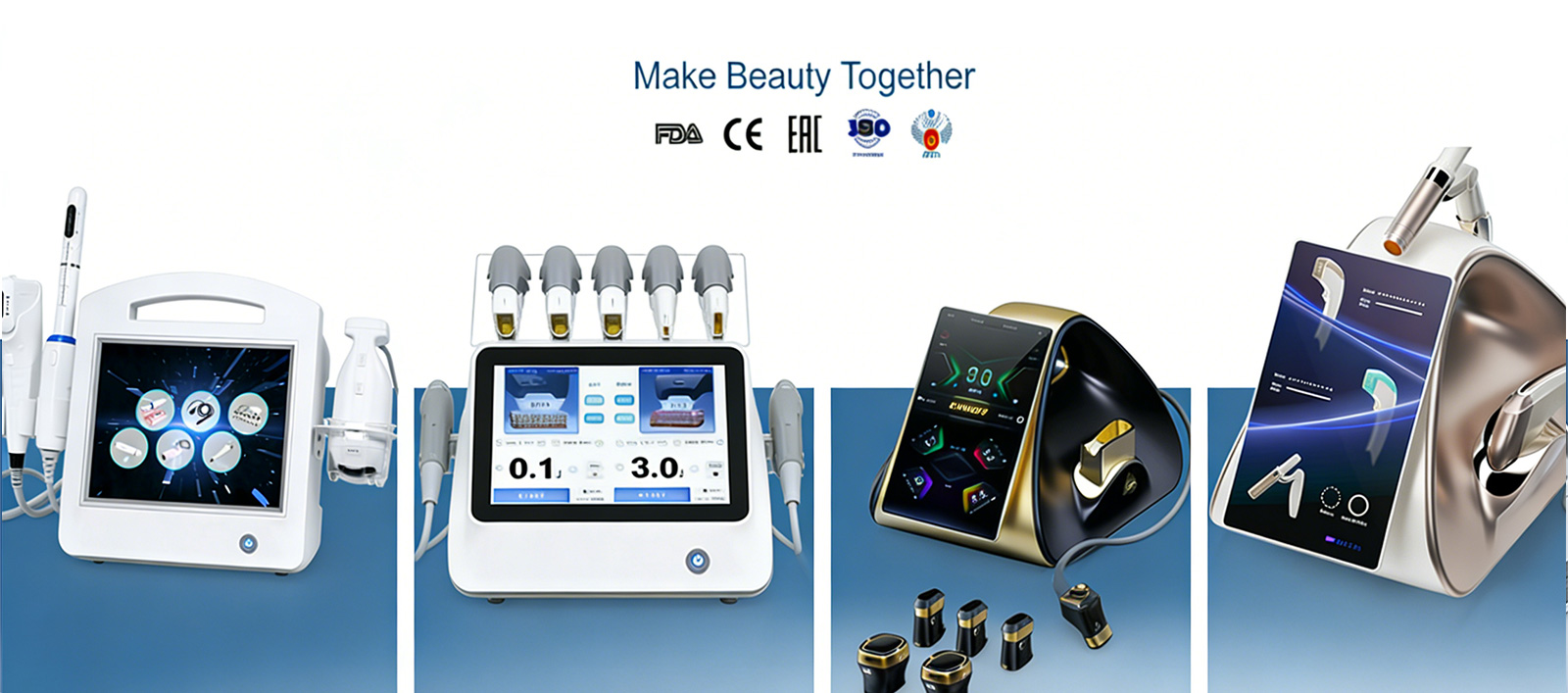
Looking for a professional HIFU system? See UangelCare’s HIFU Machine collection for multi-function devices with face, kropp, and vaginal cartridges.
What Is RF Microneedling and How It Works
RF microneedling combines two collagen-stimulating mechanisms: mechanical micro-injuries from fine needles and thermal energy from bipolar radiofrequency delivered through those needles.
Mechanism of Action
- Sterile needles penetrate the skin at controlled depths (0.5–7 mm)
- At the target depth, bipolar RF energy is released from the needle tip
- The RF generates heat (typiskt 40–60°C) in the surrounding tissue
- This creates controlled thermal zones that trigger wound healing and collagen production
- The micro-injuries themselves also stimulate growth factor release
Behandlingsdjup
| Djup | Target Layer | Clinical Effect |
|---|---|---|
| 0.5–1.0mm | Epidermis/upper dermis | Pore refinement, fina linjer |
| 1.5–2.5mm | Mid-dermis | Rynkminskning, texture improvement |
| 3.0–4.0mm | Djup dermis | Acneärr, djupa rynkor |
| 5.0–7.0mm | Subcutaneous layer | Body scarring, deep contouring |
Key RF Microneedling Specifications
- Needle count: 25–49 needles per tip (varies by model)
- RF-frekvens: 1–3 MHz
- Needle depth: 0.5–7 mm (justerbar)
- Energy output: 0.5–50W (varies by model)
- Behandlingstid: 20–45 minuter (hela ansiktet)
Explore professional options at UangelCare’s RF Microneedle Machine page — OEM/ODM available with adjustable depth and multiple intensity levels.
Side-by-Side Comparison
| Parameter | HIFU | RF Microneedling |
|---|---|---|
| Teknologi | Focused ultrasound | Microneedles + bipolar RF |
| Energy type | Ultrasound (mechanical + thermal) | Radiofrekvens (thermal) |
| Maximum depth | 4.5mm (ansikte), 16mm (kropp) | 7mm |
| Unique depth | SMAS layer (4.5mm) | N/A |
| Skin surface broken? | Inga | Ja (micro-punctures) |
| Driftstopp | 0–1 day (mild redness) | 2–5 dagar (rodnad, mild swelling) |
| Pain level | Måttlig (deep heat sensation) | Måttlig (topical numbing recommended) |
| Sessions needed | 1–2 (visible after 1) | 3–6 (for scarring) |
| Results onset | 2–3 månader (peak at 6) | 1–2 months (peak at 3–4) |
| Results duration | 12–18 månader | 6–12 månader |
| Skin type safety | All Fitzpatrick types (I–VI) | Caution with IV–VI (PIH risk) |
| Primary indication | Lyft, åtdragning | Resurfacing, konsistens, ärr |
| Average treatment cost | $800–$2,500/session | $400–$1,200/session |
| Equipment investment | $3,000–15 000 USD | $2,000–8 000 USD |
Which Is Better for Skin Tightening?
HIFU wins for pure skin tightening and lifting. Here’s why:
- SMAS access: HIFU is the only non-invasive modality that contracts the SMAS layer. This is the structural layer that holds facial tissue in position. When it contracts, you get a visible lift — not just surface tightening.
- Collagen quantity: Studies show HIFU increases collagen density by 22–36% på 6 months post-treatment, measured by ultrasound imaging.
- Longer duration: A single HIFU session produces results lasting 12–18 months. RF microneedling typically requires maintenance every 6–12 months.
Dock, RF microneedling tightens surface skin more effectively:
- The micro-injury + RF combination triggers robust dermal remodeling in the upper 3mm
- For patients with superficial laxity, fina linjer, or crepey skin, RF microneedling produces more noticeable surface tightening per session
- Multiple sessions compound the effect — 3–4 RF microneedling sessions can match or exceed a single HIFU treatment for surface-level tightening
Clinical recommendation: Use HIFU when the patient’s primary concern is sagging, jowling, or loss of jawline definition. Use RF microneedling when the concern is surface texture, förstorade porer, or skin that looks “crepey” rather than “droopy.”
Which Is Better for Texture, Pores, and Acne Scars?
RF microneedling is the clear winner here. No contest.
Why RF Microneedling Excels
- Fractional injury pattern: The needle array creates controlled micro-wounds that trigger the wound healing cascade. This is the same principle behind fractional CO2 lasers — but with less downtime and lower PIH risk.
- Direct epidermal remodeling: Needles physically break up scar tissue. The RF heat then remodels the collagen in the treated channels. This dual action is far more effective for atrophic acne scars than ultrasound alone.
- Pore size reduction: Clinical studies show 30–50% reduction in pore size after 3 RF microneedling sessions.
- Acne scar improvement: Expect 40–70% improvement in rolling and boxcar scars after 4–6 sessions.
Why HIFU Falls Short for Texture
- HIFU bypasses the epidermis entirely. It deposits energy below the surface, so it doesn’t directly remodel the skin texture or treat scar tissue.
- Some patients notice mild surface improvement from the collagen increase, but it’s indirect and inconsistent compared to RF microneedling.
Clinical recommendation: If acne scars, förstorade porer, or rough texture are the primary concern, RF microneedling should be your first-line treatment. HIFU can be added later for lifting if needed.
Treatment Experience and Patient Comfort
HIFU Experience
- No numbing required (though some clinics offer it)
- Sensation described as deep heat with occasional sharp zaps
- More uncomfortable over bony areas (käklinjen, panna)
- Behandlingstid: 30–60 minuter
- Efterbehandling: mild redness for 1–2 hours, no visible wounds
- Patients can return to work immediately
RF Microneedling Experience
- Topical numbing required (30–45 min application before treatment)
- Sensation: tryck + heat during needle insertion
- Adjustable needle speed and RF intensity for comfort management
- Behandlingstid: 20–45 minuter + numbing time
- Efterbehandling: redness for 12–72 hours, mild swelling, tiny crusts possible
- Patients need 1–3 days before social events
Patient Compliance Factor
Ur ett affärsperspektiv, HIFU has higher treatment compliance:
- No needles = lower anxiety, especially for first-time patients
- Zero downtime = easier to schedule, no disruption to patient’s life
- Single session for many patients = fewer appointment cancellations
RF microneedling has more barriers:
- Numbing adds 30–45 minutes to each visit
- Downtime means patients must plan around the appointment
- Multiple sessions required = more opportunities for drop-off
Can HIFU and RF Microneedling Be Combined?
Yes — and the combination is increasingly popular in advanced clinics.
Why Combine Them
- HIFU addresses deep tissue (SMAS lyft, structural tightening)
- RF microneedling addresses surface (konsistens, porer, ärr)
- Tillsammans, they deliver a “3D rejuvenation” — deep lift + surface renewal
Rekommenderat protokoll
| Timeline | Behandling | Rationale |
|---|---|---|
| Week 1 | HIFU | Lift and tighten at depth first |
| Week 4–6 | RF Microneedling #1 | Surface remodeling begins |
| Week 8–10 | RF Microneedling #2 | Cumulative collagen building |
| Week 12–14 | RF Microneedling #3 | Final surface refinement |
Important Safety Notes
- Never perform both on the same day — too much thermal injury increases complication risk
- Allow 4–6 weeks between HIFU and RF microneedling in the same area
- The order matters: HIFU first establishes the “scaffold” lyfta, then RF microneedling refines the surface
- Combination packages command premium pricing: $2,500–5 000 USD for a full protocol
How Clinics Should Choose: A Business Perspective
Choose HIFU First If:
- Your patients primarily want lifting and anti-aging — this is the #1 request in clinics serving patients 35+
- You want a “hero treatment” that differentiates your clinic — HIFU produces dramatic before/after photos
- Your staff is less experienced — HIFU has a shallower learning curve (no needles, no bleeding management)
- You serve diverse skin types — HIFU is safe for Fitzpatrick IV–VI without PIH risk
- Revenue model: Higher per-session revenue ($800–$2,500), fewer sessions needed
Choose RF Microneedling First If:
- Your patients skew younger (25–40) with concerns about acne scars, porer, and texture
- You already have a lifting device (laser, thread lifts) and need a resurfacing complement
- Your market has high demand for acne scar treatment — this is one of the most in-demand treatments globally
- Revenue model: Lower per-session cost ($400–$1,200), but more sessions per patient = higher lifetime value
The Ideal Setup: Both
If budget allows, offering both technologies creates a complete non-surgical rejuvenation platform:
- Cross-selling potential: Every HIFU patient is a candidate for RF microneedling refinement, och vice versa
- Package pricing: Combination protocols generate 2–3× the revenue of single-modality treatments
- Patient retention: More treatment options = fewer referrals to competitors
- Market positioning: “Full-spectrum non-surgical rejuvenation” is a stronger value proposition than “we do HIFU” eller “we do microneedling”
Equipment Investment Comparison
| Faktor | HIFU-maskin | RF Microneedling Machine |
|---|---|---|
| Kostnad för utrustning | $3,000–15 000 USD | $2,000–8 000 USD |
| Consumables per session | $5–$15 (gel, cartridges over time) | $10–$30 (needle tips) |
| Break-even point | 5–12 treatments | 4–10 treatments |
| ROI timeline | 2–4 months | 2–3 månader |
| Staff training | 1–2 days | 2–3 days |
FAQ
Is HIFU or RF microneedling more painful?
HIFU causes a deep heat sensation with occasional sharp zaps, especially over bony areas. RF microneedling involves needle insertion plus heat, but topical numbing is applied beforehand. Most patients rate both around 4–6/10 on the pain scale. HIFU requires no numbing; RF microneedling requires 30–45 minutes of topical anesthetic.
How long do HIFU results last compared to RF microneedling?
HIFU results typically last 12–18 månader from a single session. RF microneedling results last 6–12 månader, but improve cumulatively with multiple sessions. For maintenance, HIFU requires 1 annual session; RF microneedling benefits from 1–2 sessions per year after the initial series.
Can I do HIFU and RF microneedling on the same day?
Inga. Combining both on the same day increases the risk of excessive thermal injury, prolonged downtime, and potential complications. Wait at least 4–6 weeks between modalities in the same treatment area.
Which is better for older patients with significant sagging?
HIFU is the better first-line choice for patients with moderate to significant sagging. The SMAS-layer contraction provides a measurable lift that RF microneedling cannot replicate. For patients with advanced sagging (requiring surgical correction), neither technology will produce surgical-grade results, but HIFU can delay surgery by 1–3 years.
Is HIFU safe for darker skin tones?
Ja. HIFU uses ultrasound energy, which is not absorbed by melanin. It is safe for all Fitzpatrick skin types (I–VI) with no increased risk of post-inflammatory hyperpigmentation. RF microneedling carries a low but present PIH risk for skin types IV–VI.
How many RF microneedling sessions are needed for acne scars?
Most clinical protocols recommend 4–6 sessioner spaced 4–6 weeks apart for atrophic acne scars. Patients can expect 40–70% improvement in rolling and boxcar scars. Ice pick scars may require adjunctive treatments (TCA cross, punch excision).
What’s the ROI difference between HIFU and RF microneedling machines?
HIFU machines have a higher upfront cost ($3,000–15 000 USD) but generate more revenue per session ($800–$2,500). RF microneedling machines cost less ($2,000–8 000 USD) with lower per-session pricing ($400–$1,200) but more sessions per patient. Both typically break even within 2–4 months with consistent patient flow.
Ready to add HIFU or RF microneedling to your clinic? Explore UangelCare’s HIFU machines och RF-mikronålmaskiner — professional-grade equipment with OEM/ODM support and CE/FDA certification.